I think it’s time to deal with the big bad question:

Why? Why would I have a mastectomy, as a perfectly healthy 21-year-old?

I’ve been avoiding this post for a while–not because I didn’t want to answer the question, but because I didn’t know where it would belong. It seems like something I should have written about a long time ago, before my surgery. And I did write about it, for myself, to justify the decision. But now I want to “go public” with my thought process, because people are right: removing all of my breast tissue at a young age is absolutely ludicrous.

This time last year I was driving home from work, anxiously awaiting the debauchery that would be the following evening: my 21st birthday. At that moment, I was just a normal college student. I was so excited to finally be free of my crappy fake ID, but before that magical first legal drink, I would have to make sure my camera was charged, my hair was straight, and my clutch was packed with the necessary lip glosses and eyeliners.

Celebrating my 21st birthday last April. From left to right: Marissa, Danielle, Rachel, Katy.

Six months later, everything was different. I felt nothing like that girl who was excited to go out to bars with her sorority sisters to celebrate another year. My BRCA test results were in, and it seemed that I would never be the same again.

I was suddenly resentful of my body. I felt so betrayed! My relationship with my body had never been perfect; there were certainly a wonky few years during high school. But since starting college, I’d finally become comfortable being me. And then, when things seemed to be going great in life, my body just threw me under the bus. “Oh hey! You’re gonna get cancer!” No, I guess it wasn’t my body–it was my DNA. That’s what made it even worse, at least at the time: the very essence of my being was flawed.

Oh no…not an awkward photo from high school!

No one could see that I was broken, but I knew it. I just didn’t know when it (cancer) was going to strike. My breasts were–you guessed it–ticking time bombs (oh so that’s where the name comes from!) Every time I caught a glimpse of them in the mirror while changing, I shuddered. I hated them. I didn’t trust them. What if there was a cancerous cell lurking in them already?

The BRCA test results felt like a death sentence. But maybe that’s the wrong way to describe it…I never thought I was going to die…but I never thought I was going to live, either–at least not happily and cancer-free. It was a death sentence for my normal, relatively simple life. It was a sentence for cancer. I read up on the numbers, and I knew how BRCA had played out in my own life: my mom had been diagnosed with breast cancer twice. The fact that I, too, was BRCA positive meant that I was going to get cancer. There wasn’t hope that it would skip me or that I could diet and exercise my way out of it. No. If I lived long enough and had enough breast tissue, I was going to get breast cancer.

These two thoughts–resentment toward my body and belief that I would eventually have cancer–were what drove me to my decision to have a prophylactic mastectomy.

I really hate being depressed. I hate hating myself. I wanted, so badly, to get back on track with my self-esteem and self-image. You can only truly love someone if you love yourself first, and I really hated myself last October when I found out about my BRCA mutation. Imagine how poor Bryce felt?

It’s true that I could have waited one year, five years, ten years–any period of time, perhaps–before having a mastectomy. And I think that if I had waited a few years, I still would have been doing it by choice, not by necessity. But I know that I would have felt so much self-loathing during that time. I was not prepared for those feelings. The drama of my teenage insecurities was hard enough; I did not want to repeat any of that. The sooner I got on with my mastectomy, the sooner I would have reconstruction. The sooner I would have reconstruction, the sooner I would love my breasts–and myself–again.

A mastectomy and reconstruction would give back what the BRCA mutation had taken: my self-esteem. But it would also give me peace of mind. Many women who are at high-risk for breast cancer opt for the surveillance option instead of surgery. They are diligent about their mammograms, MRIs, and breast exams and join special hospital programs for high-risk women.

This was certainly a choice I could have made, but it was too passive. Yes, I could screen the heck out of my breasts, but that wouldn’t stop a tumor from forming. And let me tell you: I’m a worrier. If something hurts (my eyes, my ears, the space between my toes), I go to the webMD Symptom Checker and diagnose myself (and it’s always terminal). Imagine me at a yearly MRI or mammogram? I just know I would be freaked out for days waiting for the results.

Remember when I thought I had esophagus cancer? Thanks, webMD Symptom Checker.

And the way I saw it–again, based on the numbers–was that eventually one of those MRIs or mammograms would come back with a spot. I would get the spot biopsied, and then a doctor would tell me that I have cancer. The doctor, knowing that I have a BRCA mutation, would then strongly suggest a double mastectomy, followed by chemotherapy and maybe radiation.

I would not get to pick when this happened. Cancer would not care if I had a career and children to think of; it would just strike. I would have to halt my life for surgery and a very difficult treatment; I would have to explain to my family what was wrong with me. My mom didn’t get to pick when she was diagnosed with breast cancer. It just happened to her, and at a really sucky time.

When I found out that I had a BRCA mutation, I was given a choice–the choice my mother never had. I could choose when my life would be inconvenienced. I could decide if I wanted it to be because of cancer, or because of me. I decided to stop my life for a few weeks because of me–because of a decision I made myself. If I had decided against a prophylactic mastectomy, I would have to have one at some point, anyway…and it wouldn’t be prophylactic anymore. It would be because I had breast cancer.

My brother Michael put it best in an email to me a few days before my surgery: “Doing this [a mastectomy], or not doing this, are each big decisions.  One choice is potentially fatal, and one is just fucked up.  You chose fucked up, which is clearly the right choice.”

He’s right. It is “fucked up.” It’s ridiculous. It’s upsetting. I was distraught for weeks before my mastectomy, and sometimes now, even after, I get angry and sad and insecure. But it was the right choice. I didn’t cause the stop codon that screwed up my BRCA2 gene. Nothing I ate, drank, said, watched or smelled affected it in any way; it just happened. I couldn’t control it. But now I am in control of my body and health again, and I have my prophylactic mastectomy to thank for that.

I know blogs are supposed to be concise…and that certainly wasn’t. But I hope it made sense. I hope that at least one person out there understands my decision a bit more…I hope it doesn’t seem so crazy and extreme.

I want YOU to get tested for the BRCA mutation in 20 years so you can take control of your health again, future self!

Tomorrow’s my 22nd birthday, and I’ve given myself the gift of life! So cheesy, and so true.


What would you do if you knew you were going to get cancer?

What would you do if you knew you were going to get cancer? You don’t have it, yet—but it’s coming for you! Could be in twenty years; could be in ten. Could be in fifty years; could be in six months.

That was my situation. After my mom was diagnosed with breast cancer for the second time in September of 2011, she was tested for genetic mutations of the BRCA genes, a class of tumor suppressors that work with reproductive tissue. She tested positive for the BRCA2 gene, which is linked to an increased risk of breast cancer. As all good students who were awake for at least one Biology lecture should know, genes are passed down through parent to child. There was a 50% chance I had inherited the same BRCA2 gene mutation.

Even before I made the decision to be tested for the mutation, I knew there was a higher likelihood that I would be diagnosed with breast cancer at some time in my life. My mother was diagnosed for the first time at a relatively young age, which made me more susceptible. Since my outlook was already somewhat pessimistic, being tested for the BRCA2 mutation wouldn’t change much.

I waited almost two weeks for the results of the blood test and finally heard back on October 25th, 2011. Yes, the results were positive: I had inherited the same mutation as my mom. I was not surprised by the news but that doesn’t mean I was not upset, either. The numbers are pretty daunting:

  • The BRCA2 mutation means I have a 56-87% chance of developing breast cancer by age 70
  • It also means I have a 27-44% chance of developing ovarian cancer by age 70
  • I have a slightly increased chance of developing other cancers, such as pancreatic and stomach
  • I have a 50% chance of passing this genetic mutation onto my children

So pretty much, I realized I was going to get breast cancer…that’s how the numbers played out, and my mom’s history of breast cancer confirmed those numbers. Yep, I was pissed. For a few days there I felt like nothing in life was “important” anymore, that school and work didn’t matter because I had much bigger issues to deal with and I couldn’t possibly be bothered by the mundane, menial tasks of everyday life!

Right, clearly that’s a stupid attitude. After moping around a bit I realized I needed to get over myself and stop acting like a little drama queen. I needed to take action!

My options were as follows:

1. Do nothing now. Start routine mammograms around age 40. Hope that there aren’t any cancerous cells lurking in my body.

2. Begin yearly MRIs and mammograms at age 25, which would (most likely) catch any cancer early, making it easier to treat.

3. Opt for a prophylactic mastectomy to remove all of my breast tissue, dramatically reducing my chance of getting breast cancer

Well, you guys all know what I picked! A prophylactic mastectomy. It seems so drastic, I know, but it’s the only active route. Why would I wait for cancer to strike me when I could kick its ass right now? Although the yearly MRI and mammogram option is a smart one, I believe that it’s too passive because I would just be waiting for a cancerous lump to appear. When that lump did appear, I would end having a double mastectomy anyway, in addition to chemotherapy and radiation.

By opting for the prophylactic mastectomy, I’ve essentially lowered my risk of breast cancer to almost 0%. And there are more bonuses: I won’t have to go through chemo or radiation; I won’t have to put my career on hold; I won’t have to explain to my kids why I’m bald; I can pick the best time and place for me to have surgery; I’m still covered by my parents’ insurance; and most importantly, my mommy will be there to take care of me after!

My surgery was on March 13th, at Ronald Reagan Hospital at the UCLA Medical Center. I know, I know, I’m a USC traitor—but these doctors are incredible. I am so confident in them. Plus, my plastic surgeon was also my mom’s plastic surgeon when she had her mastectomy back in November, and he did a great job with her reconstruction.

Oh yeah, that’s something I forgot to mention: reconstruction! I’m not going to be flat-chested, woohoo! I’m going to be getting silicone implants. But first, in order to prep my body for the implants and to make sure they are spaced correctly, I have tissue expanders. Tissue expanders are pockets of saline that are placed underneath the chest muscle. Over time they are gradually filled up with more saline. Once they are at my “ideal” breast size, the tissue expanders will be switched out for the silicone implants.

I’m using this blog as a way to shed light on this issue. It’s a pretty niche topic; not many resources exist for women like me. Throughout my posts I’ll be documenting my progress after the surgery. I’ll also backtrack and give background on my family history of breast cancer and how its presence in my life led up to my ultimate choice to have a prophylactic mastectomy.

Thanks for reading!

November 2011: Mom’s mastectomy

Following Mom’s second breast cancer diagnosis in September 2011, she was tested for a BRCA mutation. She tested positive, explaining why she had been targeted by breast cancer twice in only twelve years.

Twelve years ago, in 1999, she was given the choice between a mastectomy and a lumpectomy. Twelve years ago, she didn’t know about the BRCA genes; not many people did, since the BRCA genes had only been discovered about five years earlier. Why have a mastectomy when the cancer tumor could be removed, and any remaining cells could be attacked with chemotherapy and radiation? A mastectomy meant losing her breast and dealing with even more surgery; a lumpectomy seemed like a much easier solution. So she had a lumpectomy.

Twelve years later, it was obvious that a mastectomy would be the smart choice for dealing with this second case of breast cancer. Her BRCA mutation meant that any breast tissue could turn lethal; having a lumpectomy might only be a temporary stop to breast cancer.

On November 9, 2011, we drove over to UCLA Medical Center at the crack of dawn for the mastectomy. Mom had showered and braided her hair the night before and was in all around good spirits. The three of us (Mom, Dad, and me) waited in a small pre-op room. Throughout the next hour, various people popped in to say good morning and explain any last minute surgery details: We saw her breast surgeon, Dr. Helena Chang; her (and later my) plastic surgeon, Dr. Jaco Festekjian; and many members of the anesthesiology team.

Here we are before Mom’s mastectomy…notice her braids! Smart choice.

Mom’s breast reconstruction, done by Dr. Festekjian, was a combination of a DIEP Flap procedure and a tissue expander insertion. Fat tissue from her stomach was used to create a left breast (the DIEP Flap procedure). This was necessary because her left breast, which had been radiated twelve years before, could not support an implant. Some women are able to use the DIEP Flap procedure to recreate both breasts, but Mom was too skinny for that! A tissue expander (like mine!) was inserted under the muscle of her right breast.

Dad and I sat in the hospital waiting room for hours during her surgery. A television screen monitored the progress of each patient, tracking if they were still in surgery or if they had been moved to a recovery room. After more than eight hours, Mom was moved from a recovery room to a hospital room. We were finally allowed to see her.

As expected, she was very drugged up and was also having problems with nausea. But she’s a trooper, and the next few days were easier. I tried to visit her each day after work or school, bringing her food or small gifts. One present was a 20 Questions electronic game. We had a lot of fun with that one, and her nurse was delighted because she had recently purchased the same toy for her grandson but had no idea how to use it! It’s a good thing I was there to teach her. =P

The 20 Questions toy!

After Mom’s mastectomy, her breast tissue was sent to a lab to be biopsied. Since she already had breast cancer, they studied the tumor to determine the next course of action. We were all delighted when Dr. Chang called to say that the tumor was very small and contained, meaning that chemotherapy would be optional! Yahoooooo!

Since it was Mom’s choice and she had already gone through the trauma of chemotherapy and radiation once before, she opted to forgo the optional extra treatments.

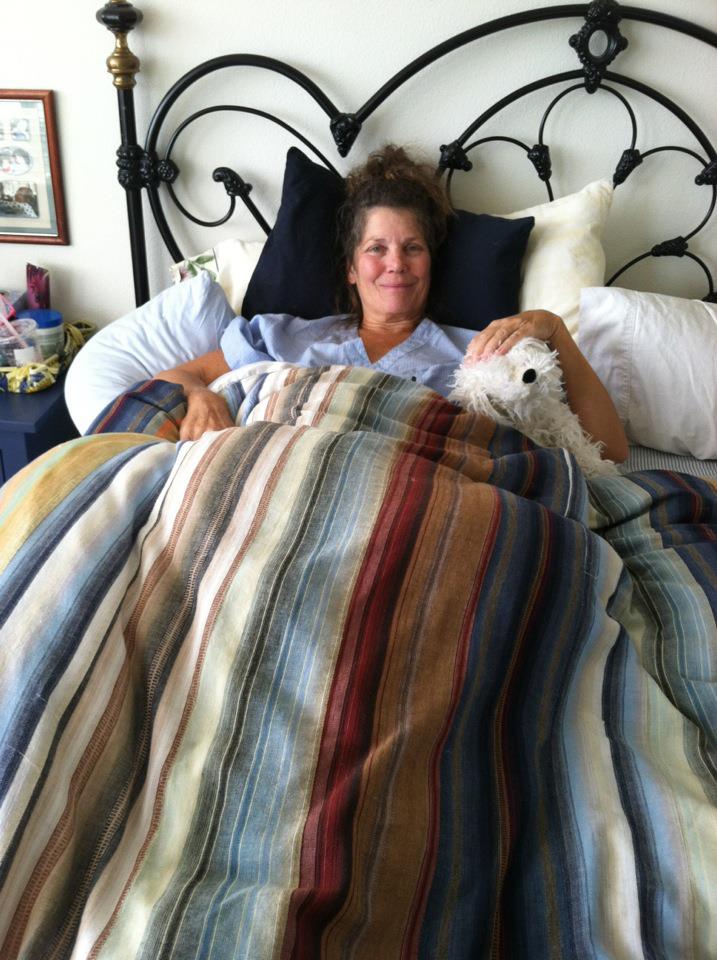
Mom, relaxing at home in bed in the days following the mastectomy. Note the Stuffed Usurper, a stuffed animal version of our dog Madeline, who was on vacation in San Diego with her auntie and uncle.

Over the next few months, Mom returned to Dr. Festekjian to have saline inserted into her tissue expander. She also started to see Dr. Amer Karam (my breast surgeon…isn’t he cute?!) about having a prophylactic oopherectomy. Dr. Karam is a gynecologic oncologist and breast surgeon–a true Renaissance man!

A BRCA mutation is not just about breast cancer; it also means an increased risk of ovarian cancer. Since Mom went through menopause already, removing her ovaries (an oopherectomy) was a practical decision.

The timing worked out that Mom’s oopherectomy could be at the same time as her implant exchange surgery, on February 27, 2012. Dr. Festekjian swapped out the tissue expander on her right side for a permanent silicone breast implant. He also took care of a few aesthetic issues associated with the DIEP scar. Dr. Karam performed the oopherectomy.

Since both surgeries were more minor than the mastectomy, Mom was able to come home later that afternoon…and I was able to go to Vegas with my girlfriends the following weekend without worrying about her, whoohoo!

Her recovery has been great since both surgeries. When she regained strength in her upper body, Mom joined the LA Pink Dragons, a dragon boat team of breast cancer survivors. She rows with them twice a week in Long Beach, and she loves it!

Physically, she looks HOT. The DIEP Flap procedure was in essence a tummy tuck, and her reconstructed breasts are slightly bigger than before, making her a large B cup/small C cup. If you’re going to get cancer, you might as well reap the benefits of fighting it off…get a rockin’ bod!


September 2011–How it all started again

A lot happened between December 2000 and September 2011: middle school, high school, summer camp, boyfriends, proms, driver’s license, first job, traveling to Europe, going to university, sorority, internships…”the usual” for many girls.

I started September with a really positive attitude. I’d spent the summer in Europe, traveling around with my best friend and then taking classes at the University of Cambridge for a month. I returned to an exciting job as an Editorial Assistant at a web company in Santa Monica, a loving and genuinely fun boyfriend, and my parents’ new apartment right near the beach. Senior year at USC was about to start and I couldn’t wait to see what was in store for me.

My mom and I were driving to Costco to buy supplies for my upcoming Oktoberfest party when she mentioned that her usual yearly mammogram wasn’t so usual. There were some spots on her breast, but she said they were most likely harmless calcifications. She seemed nonchalant about the subject, so I didn’t think about it too much.

September 27th was a Tuesday, my day for classes. At the time I worked in Santa Monica about 30 hours a week and managed to schedule all of my necessary classes into one day. I was in ITP 411, Interactive Multimedia Production, when my mom called.

She left no voicemail, so I called her back when I got out of class around 1 pm. I was headed to a friend’s apartment for lunch.

“I got the results of my biopsy today. My breast cancer is back.”

felakfjewlfjel;waj 3249 vjaldsjafl jl;fjr9124012-4012 dakl;fjdal;fjl;ds jfalwejfeljaflewjflkewj; That was my reaction.

Everything she said after that was a blur. I choked back tears on the phone and eventually hung up. I had nothing to say to my mom at that point.

I was pissed. SO pissed. Mad. Angry. Livid. Whatever.

I spent an hour stewing at my friend’s apartment. She turned on an episode of Friends and I let a feeling of numbness take over. But after a while, I felt antsy. My next class started at 2 pm…there was no way I was going. I sent the following cryptic email to my professor:

I just wanted to let you know that I’m not going to ITP 300 today. My mom decided to call me right after ITP 411 to tell me some pretty shitty family news and I really don’t feel like staying around USC right now. Anyway  I just thought you should know so that you don’t think I’m just skipping class for fun. This is a pretty awkward email so you don’t have to respond to it. Sorry. I’m not feeling very articulate right now. see you next week.

I walked home and jumped in my car. I know, I know–you’re not supposed to drive when you’re emotional. But what the hell was I supposed to do at USC?

I had told my boyfriend earlier in the day that I would drive out to see him after class, so I got on I-10 East and headed toward his house. As a sort of warning I sent him an even more cryptic text message:

My mom’s breast cancer is back. I don’t want to talk about it. Just letting you know.

If it had been my choice, I would not have told him. I would not have told anyone about it.

I drove and cried. Cried and drove. Screamed, yelled, cried. Snarled even. Drove.

Somewhere along the way, the song “Walk” by the Foo Fighters came on the radio. Dave Grohl is speaking to me in this song, I thought to myself:

A million miles away
Your signal in the distance
To whom it may concern
I think I lost my way
Getting good at starting over
Every time that I return

I’m learning to walk again
I believe I’ve waited long enough
Where do I begin?
I’m learning to talk again
Can’t you see I’ve waited long enough?
Where do I begin?

The song “Walk,” besides helping the Foo Fighters to win Best Rock Song at the Grammy Awards, would become my anthem for the next few months. September had suddenly taken a very, very bad turn.


Rachel does the 3-Day

When I was nine, breast cancer didn’t mean much to me beyond knowing that my mom was sick. But as the years progressed, I started to understand more about what cancer was and how lucky our family was that my mom was healthy again.

Part of this understanding was developed from my mom’s participation in the Avon (and later Susan G. Komen) 3-Day walks: sixty miles of walking over three days to raise money for breast cancer. By 2005, she had either walked or crewed five different events.

The minimum age for participation in the 3-Day is 16, so by the time I was 15, I knew I would be participating in a walk the following year. We formed a team of walkers called 4H: Horned Hoofers for Healthy Hooters. The team consisted of me, my mom, my mom’s best friend Arlene, my best friend Lindsey, Arlene’s daughter Erin, and a woman named Barbie who worked with Arlene.

A training walk in San Francisco…Arlene got our team Hooters shirts, and we ran into some of Mom’s walking buddies along the way! (L to R: Lindsey, Rachel, Arlene, Shirley)

It was so nice to have an experienced walker (my mom) to organize all of our training walks. Our schedule was pretty consistent: during the week, Lindsey, Mom and I would try to do at least two short, local walks. On the weekend we would meet as a group to do longer walks. The location of these longer walks often varied: sometimes we would walk around San Francisco and across the Golden Gate Bridge into Sausalito; other times we’d go on hikes around nature preserves in the Bay Area.

Besides training, I also had to fundraise. In order to walk, I needed to raise $2,200. This was the tricky part, but I made it work. I wrote letters to friends and family giving information about the event and discussing how breast cancer had impacted my life. People who wished to donate could either do so via snail mail or online. My friends and family came through with flying colors, graciously helping me to pass the goal of $2,200.

The actual Susan G. Komen Breast Cancer 3-Day was in San Diego in November of 2006. At the start of our training a year earlier it seemed like walking twenty miles a day for three days was an impossible goal to reach, but by the time we made it down to San Diego, it was reality. Five to seven mile training walks had been replaced by sixteen to nineteen mile treks, and we were ready to go!

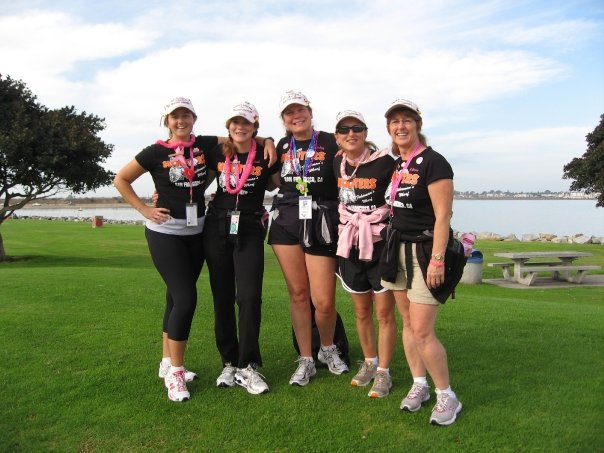
Team 4H: Horned Hoofers for Healthy Hooters (L to R: Lindsey, Rachel, Shirley, Barbie, Arlene)

The 3-Day was amazing. Seriously, if anyone is considering walking you should do it, it’s so much fun. San Diego was a great location; the walking route was beautiful! And the community embraced us…there were supporters on the sidelines, handing out popsicles, pins, beads–even wine! At night, we camped out in tents. Hot meals were provided for us, and there was even a shower truck!

Lindsey and me, keeping clean near the shower trucks.

Even though my feet hurt and I developed blisters, I kept walking throughout those three days because of the rush of adrenaline I got:

  • People were cheering me on everywhere I turned.
  • There were cute bike cops from San Jose riding alongside us.
  • If I really wanted a break I could hop into a “sweep” vehicle that was decorated with boobs and would drop me off a mile further along the route.
  • The snacks were delicious.
  • Sometimes we’d walk by the beach and see shirtless surfers…Lindsey and I always cheered.

All in all, it was a pretty good deal: raise a couple thousand dollars in order to have the time of your life!

Just chilling with some San Jose bike cops along the route!

Our team loved it so much that we decided to walk again in 2009. This time it was a bit less organized; I was at USC, Lindsey was at UCSB, and Mom and Arlene were in Northern California. We didn’t have the luxury of a consistent training schedule, but we made it work! Our new team name for the 2009 event was Doppelgangers.

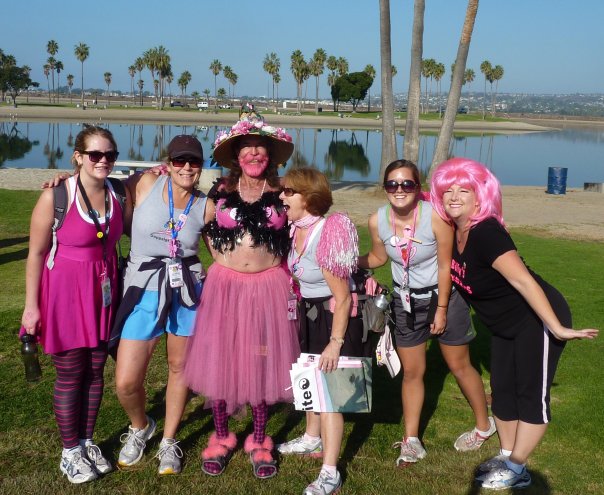
Team Doppelgangers, posing with some fans along the route.

Throughout all of the 3-Day events my mom and I have participated in, our combined contribution to breast cancer research has been over $40,000. We couldn’t have done it without the support of our friends and family. All in a 3-Day’s work!


Mom goes for a walk

Within one year of finishing chemotherapy and radiation, Mom decided to go for a walk. A really, really long walk. (No, not a long walk off of a short pier–we didn’t drive her THAT crazy!)

In July 2001 she completed her first Avon Breast Cancer 3-Day walk. Surely everyone knows about these type of events now: if you’re one of the few people in the world who hasn’t been on the receiving end of a fundraising letter from me or my mom, you have to at least know that organizations like Susan G. Komen, Avon, Nike and Revlon are really into these “Race for the Cure” and “Woman’s Marathon” events to benefit cancer research.

For months, she trained and trained and trained. The actual walk in San Francisco was three days and 60 miles long. To put it into perspective for those non-walkers: that’s a helluva lot of walking!

She also fundraised. For every 3-Day walk (at the time it was sponsored by Avon; now the Susan G. Komen Foundation organizes the 3-Day) participants must raise a minimum amount of money that is put toward breast cancer research; in 2001, it was $1,900.

She joined a team of walkers in the Bay Area. They met twice a week to train, completing walks all around the Bay Area. At first the walks were short; 5-7 miles. But as the months passed and the 3-Day became closer, the training walks lengthened; 15-20 miles. That’s a lot of water, blisters, and pairs of socks.

The 2001 3-Day officially started on Friday, July 27th in Menlo Park, California. It ended on Sunday, July 29th at Marina Green in San Francisco with a 5 pm closing ceremony. My dad decided we would go into the city that Sunday to cheer on Mom at the end of the walk. I remember how amazed I was by the number of walkers. There were just so many people!

“The Journey Begins” photo from http://www.abekleinfeld.com/Avon%20Walk1.htm

The most memorable part of the experience was definitely the Survivor Circle. At the start of the closing ceremony, each walker was given an official 3-Day t-shirt; most were blue, but the breast cancer survivors received pink shirts. All of the survivors walked into the closing ceremony together. I knew my mom was one of them! A touching moment for an eleven-year-old.

After that first 3-Day in 2001, my mom was bitten by the 3-Day bug. For the next four years, she was either walking or crewing an event:

  • 2002: she crewed the San Francisco 3-Day
  • 2003: she walked the Santa Barbara 3-Day with my aunt Jackie
  • 2004: she walked the San Francisco 3-Day with her friend Skylar
  • 2005: she crewed the San Francisco 3-Day

That’s a lot of walking, and a lot of fundraising! Crew members don’t walk (they handle all of the behind-the-scenes work that makes the event fun for the walkers), but they still have to fundraise. Between all of these walks (and the two she did with me; see the later blog post), my mom raised $35,000 for breast cancer research!

You can put a number on the amount of money raised, but the memories a 3-Day walker has from the event are priceless. Aww, cheesy, I know.

For further reading about the event, take a look at these two articles from 2001 in which my mom is quoted:

Training together for 60-mile trek from the Pleasanton Weekly

Sole mates band together for breast cancer walk from the SF Chronicle (I see what they did there with the title hahaha)


Twelve years ago

Twelve years ago, I was a carefree nine-year-old who had just moved from Boston to San Francisco. School was going well, my parents promised to buy me a dog for Christmas, and I’d joined a soccer team.

Rachel and Madeline, early 2000

My head was in the clouds. I don’t remember much about my mom having cancer; I just knew she was sick. It didn’t mean very much to me.

In October of 1999, while getting dressed for work in the morning, my mom found a lump in her left breast. An October 14th mammogram and ultrasound revealed a “9 x 11 mm mass with ill-defined, indistinct margins.” An October 22nd biopsy confirmed it as a “grade 2 infiltrating ductal carcinoma.”

Rachel and Mom, Halloween 1999. Mom made me that Sgt. Pepper costume!

My mom was given two options: a mastectomy or a lumpectomy (at the time, doctors didn’t know she had a BRCA mutation.) Either option would require chemotherapy and radiation.

She opted for the lumpectomy. Her first round of chemotherapy was on January 17th, 2000. By December of 2000, her mammograms were clear.

Where was I in all of this? I’m not really sure. I have no recollection of the moment she told me she was sick. Apparently she sat me down and explained, as best she could to someone who would prefer to ride a bike than to talk about medical problems, that she was ill but she was getting treatment and would be okay in the end. After she was done talking, I asked for a cup of tea.

Either I absorbed the news so well that I was going to reflect on it with a nice cup of Earl Grey, or I had no idea what to do with the information and was looking to change the subject.

One day we went shopping for wigs. It was a lot of fun, but boy, was it overwhelming. There was so many styles. At the time, my mom’s hair was a curly ash brown, styled in a short, almost cropped cut. But the wig she picked wasn’t like her hair at all: it was auburn, a shoulder-length bob. And she never actually wore it–why did we pick it?

“Why?” Those were the type of questions I remember.

“Why is your mom bald?” That was the worst one, my most vivid memory of my mom’s breast cancer. I was in my fourth grade class giving a presentation about animal abuse. I’d invited a local newspaper columnist who wrote about animals to speak to the class. My parents were so proud of me; they came to watch my presentation and to meet the columnist.

Mom wore a green, flowery dress that touched the floor and a purple knit hat. It was obvious that she had no hair: even the shortest of cuts would have had at least some strands poking out the back. The hat was a way of protecting the rest of the world from cancer, of shielding the problem and letting everyone ignore it.

So when a boy named Michael asked why my mom was bald, I was taken aback. Didn’t he know he wasn’t supposed to ask that kind of question? Had his parents not taught him any manners? What was his deal?!

I don’t remember how I answered him. I’m sure I said something snarky.

That incident was honestly the most traumatic breast cancer-related moment of my childhood. By the time fifth grade started, breast cancer seemed like a thing of the past. Mom was done with chemo and radiation, her hair was growing back, life had resumed as normal. Breast cancer, it seemed, had only been a minor hiccup.